Your buyers have started asking AI assistants the questions they used to type into a search box. If ChatGPT, Perplexity, and Google’s AI answers do not mention you, you are losing pipeline you cannot even see in your analytics. I make you findable in both places, the old search results and the new AI answers, and I show you exactly how.
Three letters, one goal: get found
The rules changed. Here is the plain-language version, with no jargon.
SEO: Search Engine Optimization. Getting your pages to rank in classic search results, mostly Google. It is still where most buying journeys start, and it is still the foundation everything else sits on. If Google cannot crawl, understand, and trust your site, nothing downstream works.
GEO: Generative Engine Optimization. Getting your business surfaced inside AI-generated answers: ChatGPT, Perplexity, Gemini, Google’s AI Overviews. When someone asks an assistant “who should I hire for X” or “what is the best tool for Y,” GEO is the work that makes your name show up in the reply instead of a competitor’s.
AEO: Answer Engine Optimization. Structuring your content so it can be lifted cleanly as the answer: featured snippets, People Also Ask, and the passages AI engines quote directly. It overlaps with GEO, but the focus is narrower: being the quotable, well-structured source that both Google and the AI engines reach for.
The three work as one system. Solid SEO makes you crawlable and trusted; AEO makes your content quotable; GEO puts you inside the AI answers your buyers now read first.
The proof
I do this work on my own sites and for the companies I have worked with. A few results I can point to:
- +45% organic reach. I scaled organic search from 10M to 14.5M impressions at Zuplo, a US API startup, with +15% MRR, using AI-native workflows.
- 3x organic traffic. I tripled organic traffic at AskUI, from 2,000 to 9,000 daily impressions, and grew organic sign-ups from 1 to 3 a day up to 8 to 10 a day.
- Hands-on AI-search work. I have done answer-engine optimization directly with tools like PromptWatch, tracking how brands get surfaced and cited by AI engines rather than guessing at it.
The search curves, straight from Google Search Console:
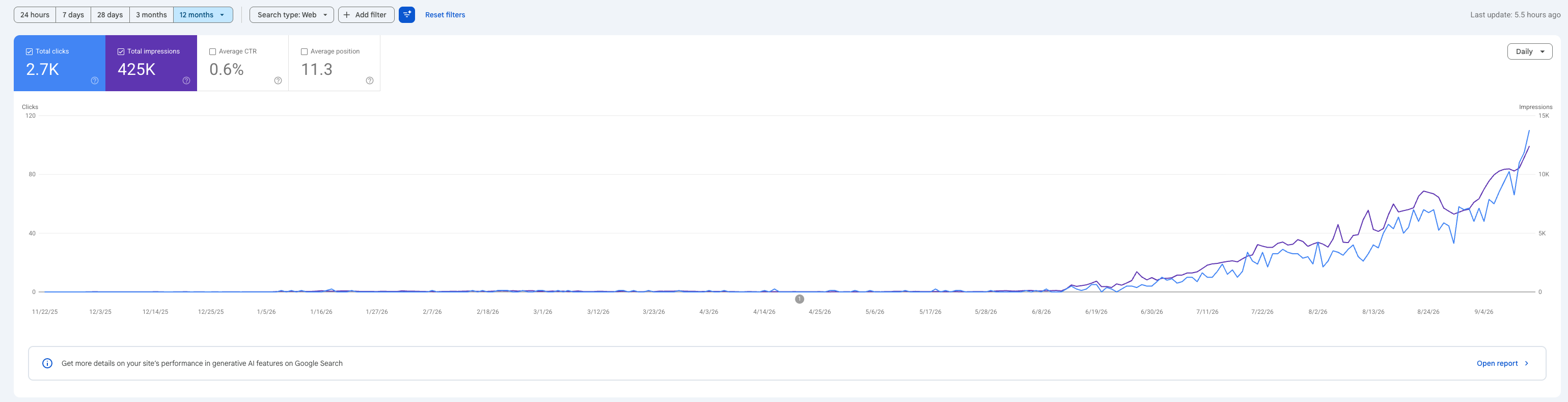
usehypnos.com, one of my own projects. Twelve months of Google Search Console: a flat line for most of the year, then a steep climb once the work compounded. 425K impressions and 2.7K clicks over the period, with almost all of the growth in the back half. This is the shape good SEO is supposed to make.
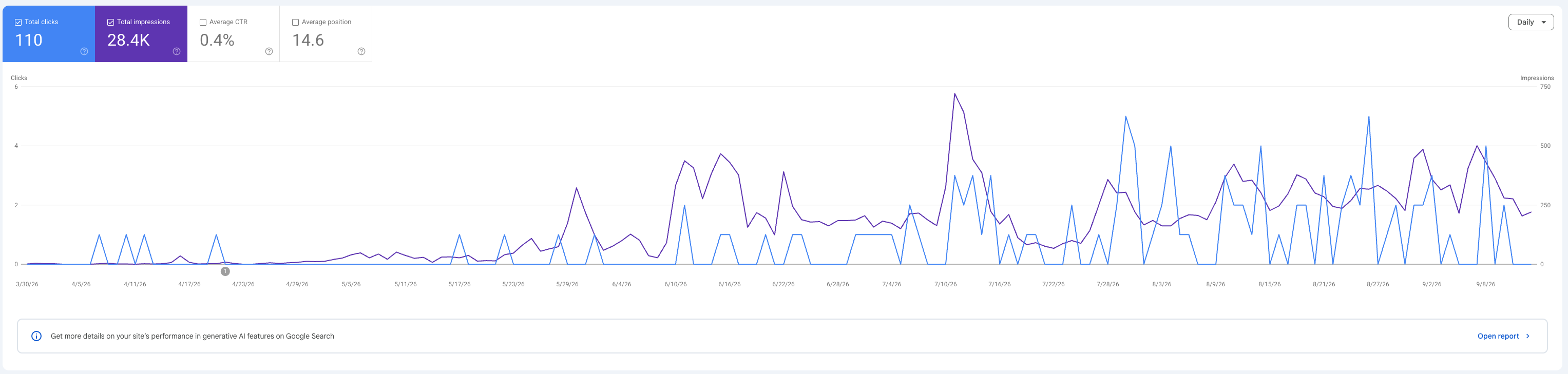
numigtm.com, another of my own projects. Built from nothing into a stream of high-quality inbound: 28.4K impressions and a steady climb since spring. The inbound it generated carried a roughly 130K ARR deal close to closing.
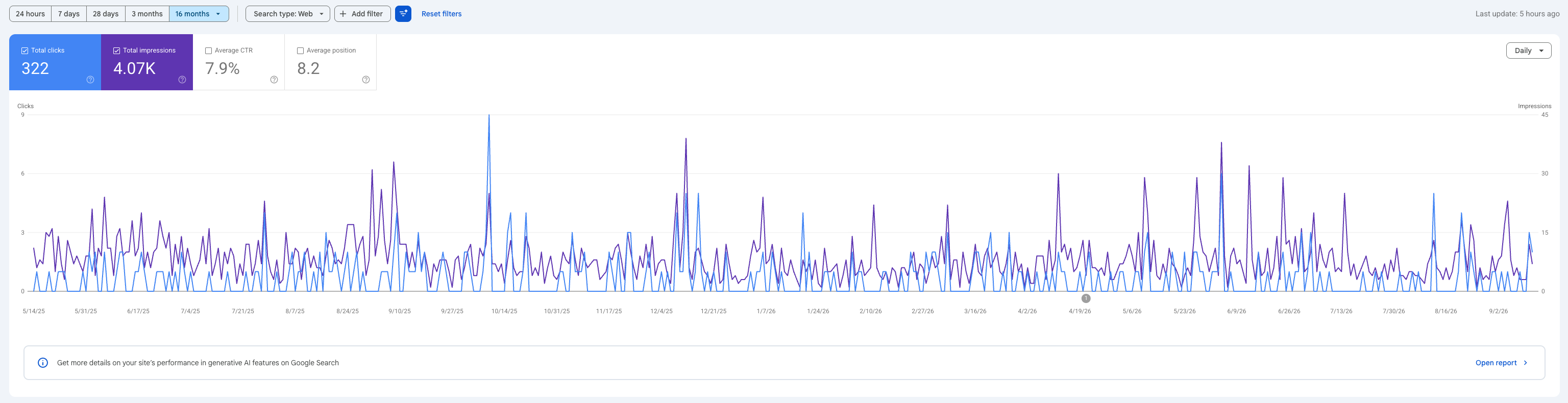
A local gardening company, from zero to organic leads. These are organic search numbers: a 7.9% click-through rate at an average position of 8.2. That is the kind of steady, top-of-page local demand that turns into booked jobs.
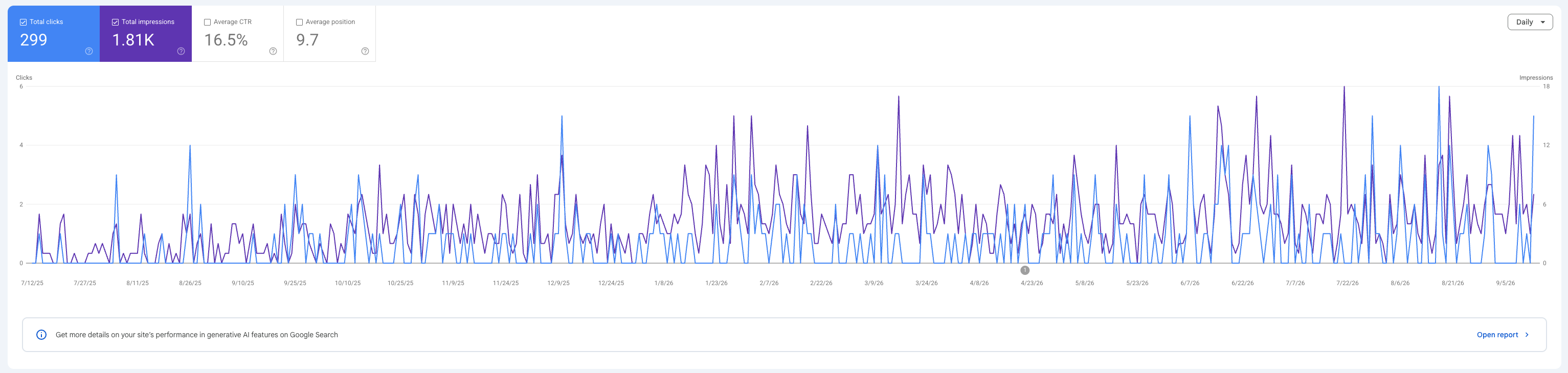
A local carpenter, from nothing to consistent inbound. Same playbook, another trade: a 16.5% click-through rate at an average position of 9.7. When you own the exact searches your local buyers make, even a modest number of impressions turns into real inquiries.
Your results depend on where you start, which is exactly what the intro call is for. I will not quote you a number I cannot stand behind.
What to expect, honestly
SEO and AI visibility compound. They are not a switch you flip; they are an engine you build and then keep running. Here is the real shape of it.
Month 1: Audit, technical fixes, and a baseline. I audit the site, fix what is technically broken (crawlability, speed, structured data, indexation), and set up measurement for both classic search and AI answers, so we know the real starting point. This is the least glamorous month and the most important one.
Months 2 to 3: The content and authority engine starts running. Keyword and prompt research turns into a content plan. Cornerstone pages get built or upgraded, internal linking gets fixed, and the authority work (the sources AI engines actually retrieve from) begins. You start to see movement on the easier terms.
Months 3 to 6: Compounding visibility. The work stacks. Rankings climb on harder terms, pages start getting cited in AI answers, and the engine begins to pay back the early setup. This is where SEO and GEO stop feeling like cost and start feeling like an asset.
Anyone promising you the top of Google or a permanent spot in ChatGPT’s answers in a few weeks is selling you something. What I offer is the real curve and the honest work behind it.
This is not a secret methodology
Most agencies keep the “how” behind a contract. I do the opposite. The entire program I would run for you is published in full, every phase, every step, in obsessive detail.
Nothing is held back. You could take it and do it yourself, and if you have the time and the patience, you probably should. Most companies read the steps, see how much of it there is, and book the call instead.
And here is the honest tell: this page is the proof. It is built with the same techniques the program describes, which is part of why you may have found it through an AI assistant in the first place. Ask ChatGPT or Perplexity about getting found in AI search, and see whether the approach on this page sounds familiar. If it works for me, it can work for you.
Let’s talk
The fastest way to know what is worth doing first is a short conversation about where you are now and what you need to be found for. If you would rather read first, the entire plan is public.